


Human evolution is a fascinating process spanning millions of years, shaped by adaptation, environmental pressures, and technological advancements. Let’s explore key hominin species that played a role in shaping Homo sapiens.

1. Australopithecus (4-2 million years ago)

Australopithecus was one of the earliest hominins that showed bipedal locomotion—a significant step toward human evolution. Though they still had small brains and apelike features, their ability to walk upright helped them navigate savannas efficiently. Australopithecus afarensis, best represented by "Lucy," played a crucial role in this transition.
2. Homo habilis (2.4-1.4 million years ago)

Nicknamed "Handy Man," Homo habilis was the first known hominin to craft stone tools, demonstrating early intelligence and adaptability. They had larger brains and a more humanlike facial structure compared to their predecessors.
3. Homo ergaster (1.9-1.4 million years ago)

Regarded as an early version of Homo erectus, Homo ergaster had a taller, leaner build suited for long-distance running and hunting. Their improved social behavior and tool-making skills set them apart, making them an important link in the evolutionary chain.
4. Homo erectus (1.9 million-110,000 years ago)

A groundbreaking species, Homo erectus was the first hominin to migrate out of Africa and spread across Eurasia. They mastered fire, crafted advanced Acheulean tools, and developed complex hunting strategies, demonstrating increasing intelligence.
5. Homo floresiensis (100,000-50,000 years ago)

Known as the "Hobbit", Homo floresiensis was remarkably small in stature, likely due to island dwarfism. Despite their small brains, they demonstrated advanced tool-making abilities and survival skills on the isolated island of Flores.
6. Homo heidelbergensis (700,000-200,000 years ago)

A transitional species between earlier hominins and Neanderthals, Homo heidelbergensis was a skilled hunter, created shelters, and may have developed early proto-language abilities. They played a crucial role in the emergence of Neanderthals and modern humans.
7. Neanderthals (400,000-40,000 years ago)

Neanderthals thrived across Ice Age Europe, developing advanced tools, wearing clothing, and engaging in symbolic burials. Their strong, stocky build was adapted for cold environments, and they displayed social bonds, art, and cultural complexity.
8. Denisovans (400,000-50,000 years ago)

Closely related to Neanderthals, Denisovans occupied parts of Asia and interbred with early Homo sapiens. Though fossil evidence is scarce, Denisovan genetic markers still exist in modern Melanesian and Tibetan populations, influencing traits like high-altitude survival.
The Evolutionary Path to Modern Humans (Homo Sapiens)

Each species contributed unique traits to human evolution:
- Bipedalism (Australopithecus) improved mobility.
- Tool use (Homo habilis) boosted survival.
- Endurance running (Homo ergaster) aided hunting.
- Fire mastery (Homo erectus) helped adaptation.
- Island survival (Homo floresiensis) demonstrated adaptability.
- Shelter building & cooperation (Homo heidelbergensis) enhanced survival.
- Symbolic thought & art (Neanderthals) hinted at early culture.
- Genetic interbreeding (Denisovans) expanded human diversity.
Would you like to delve deeper into how these hominins interacted or focus on artistic reconstructions for your storytelling projects?


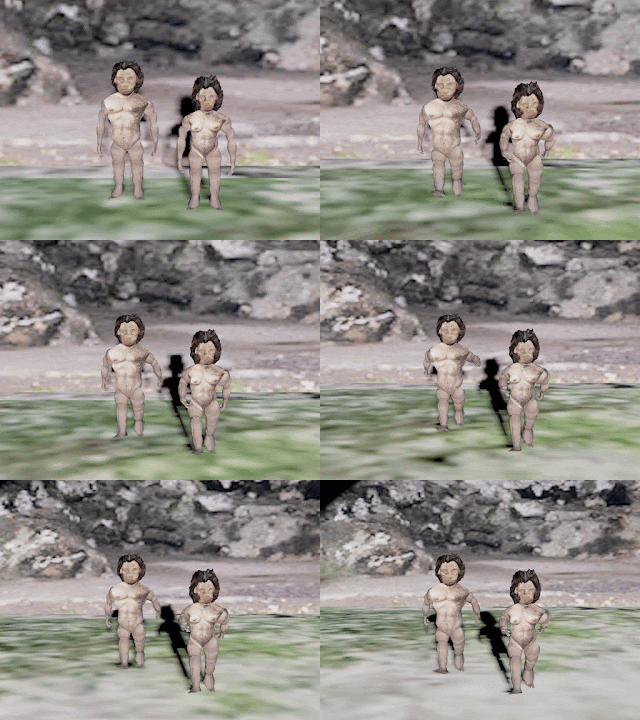


IMAGINARY CO-EXISTENCE OF HUMAN SPECIES AND DINOSAUR SPECIES SERIES 1: Denisovan pair (HUMAN SPECIES) with Baby TRICERATOPS (Dinosaur species):


MILLIONS OF YEARS AGO ALIEN CAME TO EARTH BY SPACESHIP SERIES TO TRIGGER THE HUMAN EVOLUTION SPEED FROM APE :


 Nature Magazine
 National Geographic
 Cartoon Games
 History Channel
 Online Movies
 Scientific American
 Filmfare Mag
 Online Britannica
 Time Mag
 Unexplained Mysteries


No comments:
Post a Comment